Preserve the original event record
Start with the organiser or broadcaster’s current date, year and stated zone. Keep that source beside your own conversion. An old search result or a programme thumbnail may refer to a previous edition.
Distinguish coverage start, pre-show and the actual event start when the source does. A correct conversion of the wrong milestone still gives the viewer the wrong expectation.
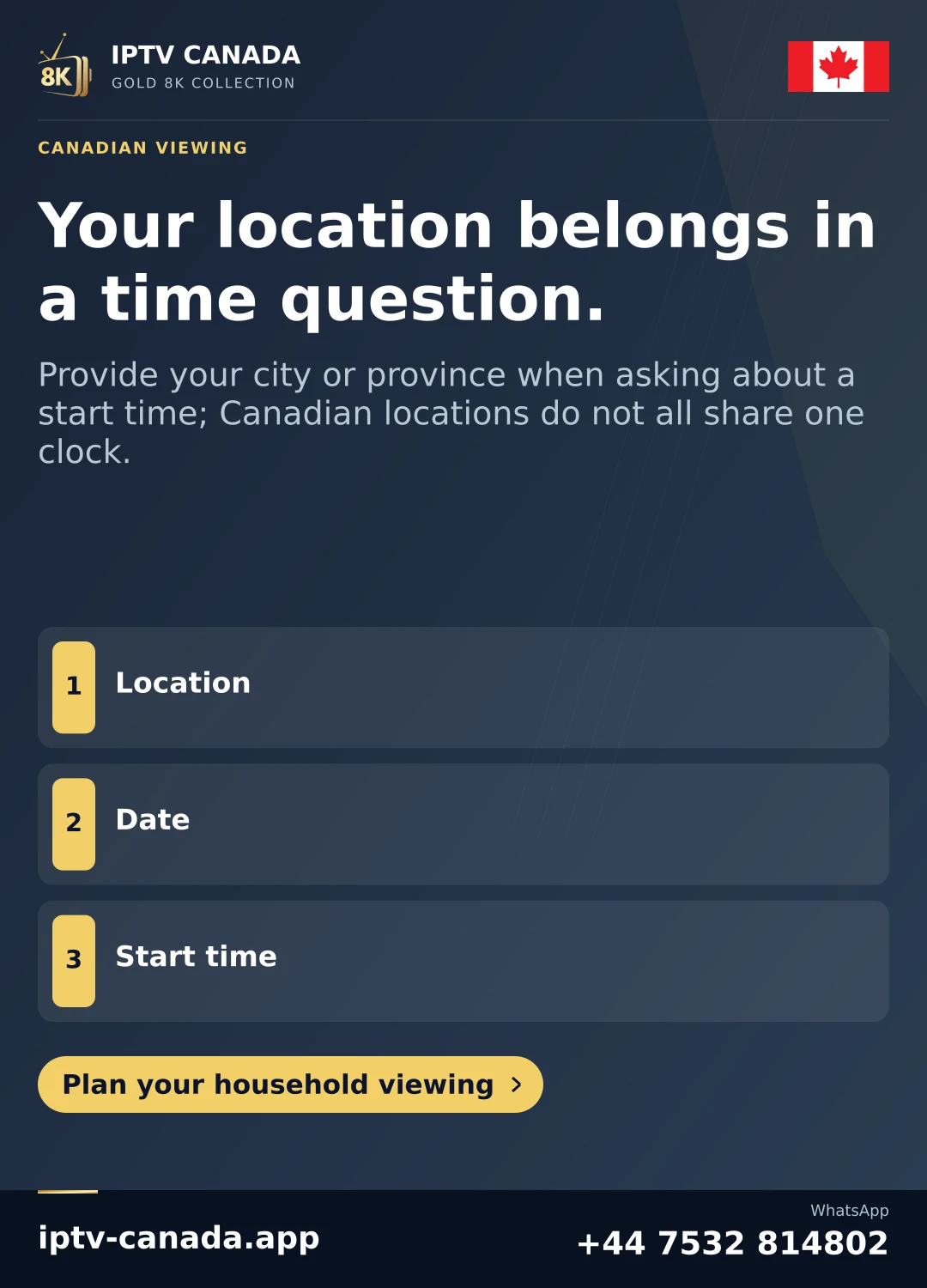
Convert with location and date
Use a current date-aware time-zone tool or calendar with the actual event date and city/zone. Do not rely on a permanent “three hours behind” rule between two places. Local time rules can change, and offsets need not be whole hours.
The NRC advises consulting provincial and territorial authorities for the most accurate current Canadian rules. In 2026, British Columbia announced year-round Pacific Time, which makes inherited seasonal assumptions particularly unsafe.
Check the programme guide separately
An EPG may display local time, source time or an account-selected zone depending on the player and data. Compare its stated setting with the event source before applying an offset. If the live picture is delayed, that is different from a wrongly converted listing.
When a programme crosses midnight, include the date in every location. A viewer can otherwise choose the correct clock time on the wrong day.
Publish a clear note
Use wording such as “source time: [date and named zone]; viewer time: [date and location]” in your own planning record, replacing the brackets with verified facts. This is a format example, not a published fixture.
Recheck important events near the date because schedules can change. This article supplies no live fixtures and makes no claim that a particular event is included in IPTV Canada. It explains how to preserve a verified schedule’s meaning.
Related questions
Can I use one time for all Canadian viewers?
Only if it is explicitly labelled as the reference zone. Readers still need a correct local conversion.
Does the video arriving late mean the time conversion is wrong?
Not necessarily. Delivery delay and schedule conversion are separate issues.
Sources and scope
Scope notes distinguish published documentation, supplied information and editorial methods. They do not report a hands-on service test.
- National Research Council: Canadian time zones — Primary reference for the narrow fact identified in the article; the diagnostic workflow is editorial guidance, not a performed service test.
- British Columbia: year-round Pacific Time and PCT — Primary reference for the narrow fact identified in the article; the diagnostic workflow is editorial guidance, not a performed service test.